How to do reverse percentages
Updated
A reverse percentage question gives you the value after a change and asks for the value before it. The whole topic comes down to one habit: find the multiplier, then divide by it. This page covers the method, eight worked examples, the mistakes that cost marks, and practice questions with the working shown.
It is a named topic on the GCSE syllabus and it appears in exams every year, largely because the intuitive answer is wrong. Outside the exam hall the same skill removes VAT from a gross invoice, recovers a pre-sale price, or works out a salary before a rise — so it is one of the few pieces of school arithmetic that keeps earning its place.
On this page
How to do reverse percentages in 3 steps
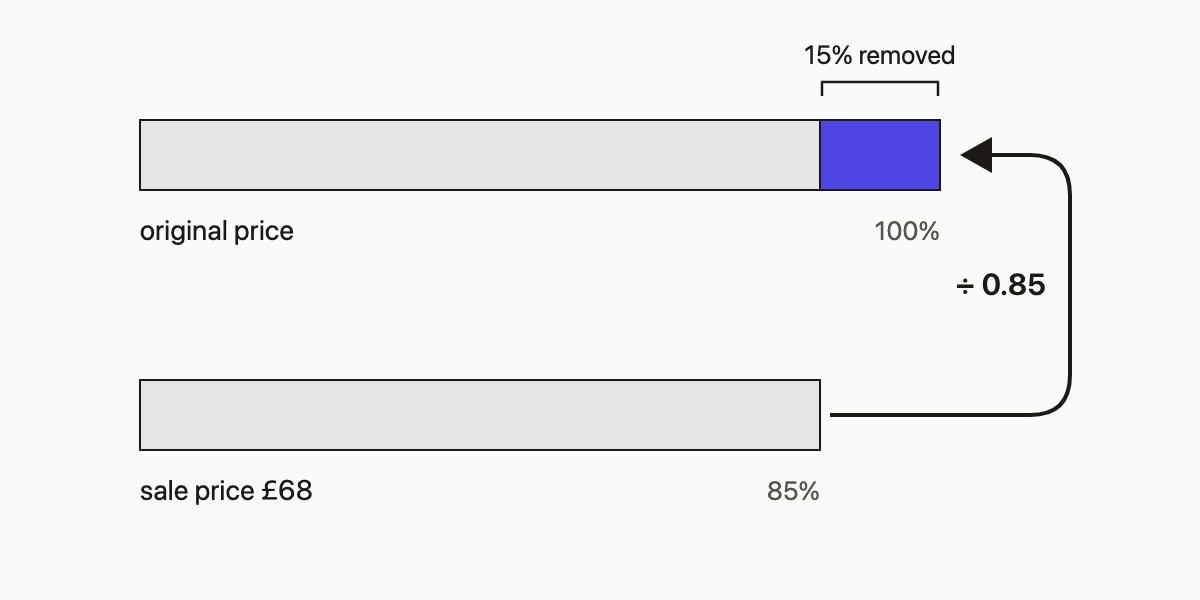
- Work out what percentage the value you have represents. After a 15% discount it is 100% − 15% = 85% of the original; after a 15% increase it is 115%.
- Divide by that percentage to find 1%. If £68 is 85%, then 1% is 68 ÷ 85 = £0.80.
- Multiply by 100 for the original. £0.80 × 100 = £80. Check forwards: £80 − 15% = £68.
The multiplier method below reaches the same £80 in a single division (68 ÷ 0.85). In a spreadsheet the whole thing is one formula — see reverse percentage in Excel.
The method, in four steps
1. Decide the direction
Did the value go up or down? A discount, a reduction or a loss means down. VAT, a pay rise, a service charge or interest means up. Getting this wrong flips the answer to the other side of the starting number, so it is worth a moment.
2. Write down the multiplier
For a decrease of p%, the multiplier is 1 − p/100. For an increase, 1 + p/100. A 15% discount gives 0.85; a 15% markup gives 1.15 (a markup is not a margin — the markup vs margin calculator shows both). Write it down even if you can do it in your head — in an exam this single line is where the method mark lives.
3. Divide
Divide the value you were given by the multiplier. Not multiply — divide. You are undoing a multiplication that already happened.
4. Check forwards
Apply the change to your answer and confirm you land back where you started. A reversed discount must give a bigger number than you were given; a reversed increase must give a smaller one. If it does not, you divided the wrong way round.
Try it with your own numbers
Open "Show steps" to see the same four steps applied to whatever you type.
Eight worked examples
| Question | Multiplier | Answer |
|---|---|---|
| A shirt costs £34 after a 15% discount. | 85% remains → 0.85 | 34 ÷ 0.85 = £40 |
| A bill is £96 after a 20% service charge. | 120% of the bill → 1.2 | 96 ÷ 1.2 = £80 |
| A rent of £715 follows a 10% rise. | 110% → 1.1 | 715 ÷ 1.1 = £650 |
| A laptop is £456 including 20% VAT. | 120% → 1.2 | 456 ÷ 1.2 = £380 |
| A town of 4,700 has grown by 17.5%. | 117.5% → 1.175 | 4,700 ÷ 1.175 = 4,000 |
| A score of 57 marks is 76% of the paper. | 76% → 0.76 | 57 ÷ 0.76 = 75 marks |
| A price fell 35% to £52. | 65% remains → 0.65 | 52 ÷ 0.65 = £80 |
| Sales doubled and then some: 240% of last year is 1,680. | 240% → 2.4 | 1,680 ÷ 2.4 = 700 |
Without a calculator: the unitary method
Non-calculator papers want the same answer by a route you can do on paper. Find 1%, then scale to 100%.
A coat costs £68 after a 15% discount. Find the original price.
- 15% off means £68 is 85% of the original.
- 1% = 68 ÷ 85 = £0.80
- 100% = 0.80 × 100 = £80
- Check: £80 − 15% = £68 ✓
It is one line longer than dividing by 0.85, but every step is visible — which is exactly what mark schemes award. If your arithmetic slips at the last step, the method marks still stand.
Two changes in a row
Higher-tier papers rarely stop at one change. The rule extends cleanly: multiply the multipliers, then divide by the product. What you must not do is add or subtract the percentages.
A price rises 20%, then falls 20%. It is now £96. What was it originally?
- Up 20% is a multiplier of 1.2; down 20% is 0.8.
- Combined: 1.2 × 0.8 = 0.96
- 96 ÷ 0.96 = £100
Notice the item ended up cheaper than it started, even though the two percentages were equal and opposite. That is not a trick of the question — it is what percentages do. The 20% rise was calculated on £100, but the 20% fall was calculated on the larger £120, so more came off than went on. Any pair of equal rises and falls leaves you below where you began.
The same logic handles VAT layered on top of a discount, compound interest across several years, or depreciation followed by a price rise. Build the chain of multipliers, multiply them together, divide once at the end. Dividing at each step also works, but rounding creeps in with every division, so one division at the end is both faster and more accurate.
When the percentage is more than 100%
An increase of 150% does not mean the new value is 150% of the old — it means it is 250% of it. The increase is added to the original 100%, so the multiplier is 2.5, not 1.5. If membership grew by 150% to 500, the original was 500 ÷ 2.5 = 200.
Decreases work differently, and the asymmetry matters: a decrease cannot exceed 100%, because that would take the value below nothing. A "120% discount" is not a hard problem, it is an impossible one. At exactly 100% the value becomes zero, and no original can be recovered — every possible starting price produces the same zero, so the information is genuinely gone rather than merely hidden.
How it shows up in exams
Reverse percentage questions are rarely labelled as such. The giveaway is the wording: the number you are given comes after something happened, and the question asks what it was before. Phrases to watch for are "in a sale", "including VAT", "after a pay rise", "having depreciated", and "which represents 85% of".
A question that says "a jacket costs £60 after a 25% discount, find the original" is a reverse percentage. One that says "a jacket costs £80, find the price after a 25% discount" is not — that is ordinary percentage work, and it uses multiplication. Two marks turn on reading which direction the question runs.
On the marks themselves: most reverse percentage questions carry 2 to 4, and the method marks are attached to identifying the multiplier. Writing "85% = 0.85" on its own line before you calculate anything protects those marks even if the division goes wrong. Candidates who go straight to the calculator and write only a final answer get nothing when that answer is wrong.
Four mistakes that cost marks
Adding the percentage back on
£210 after 20% off is not £210 + 20% = £252. The 20% came off the original, so £210 is 80% of it: 210 ÷ 0.8 = £262.50. The gap widens as the percentage grows.
Assuming two changes cancel
Up 20% then down 20% is 1.2 × 0.8 = 0.96 — you finish 4% below where you started, not level. Reverse it by dividing by 0.96, not by 1.
Confusing percent with percentage points
A rate moving from 10% to 15% has risen 5 percentage points — but that is a 50% increase. Reverse-percentage questions work in percent, so a "50% rise" means dividing by 1.5.
Multiplying instead of dividing
Multiplying by 0.85 applies the discount again. The sanity check catches it every time: reversing a discount must make the number bigger.
Why dividing works
It is worth understanding rather than memorising, because the understanding is what stops you reaching for the wrong operation under pressure.
A percentage change is a multiplication. Taking 15% off a price of P does not subtract a fixed amount — it produces 0.85 × P. That is a single operation with a single inverse. To undo a multiplication you divide, exactly as you would to undo 3 × x = 21. Nobody would answer that by subtracting 3; the reverse percentage case feels different only because the multiplier is disguised as a percentage.
This also explains why adding the percentage back fails. The 15% was a slice of P, but adding 15% to the discounted figure takes a slice of 0.85P instead — a smaller base, so a smaller slice. You get 0.85 × 1.15 = 0.9775 of the original, roughly 2% short. With a 50% discount the same error leaves you 25% adrift. The percentage is never the problem; the base it is taken from is.
Estimating the answer first
Before dividing, decide roughly where the answer belongs. The common multipliers make this quick: halving is a 50% discount, so reversing one doubles. A 25% discount means dividing by 0.75, which is multiplying by four thirds — a bit more than a third bigger. A 10% rise reversed knocks off slightly more than 9%, not 10%.
That last one catches people out and is worth sitting with. If a price rose 10% to £110, the original was £100 — the rise was £10, which is 10% of the original but only about 9.1% of the new figure. Percentages are not symmetric, and the direction you travel changes what the same percentage is worth. Estimating first means you notice when a calculator answer is the wrong size before you write it down.
Practice
Eighteen exam-style questions with the full working shown — no sign-up, no quiz gate.
Reverse percentages practice questions
Turning an exam score into a percentage is the forward question — 68 out of 80 is 85% — and the marks percentage calculator does it, with the unitary working shown.
Frequently asked questions
How do you reverse a percentage decrease?
Subtract the percentage from 100 to find what fraction remains, turn that into a decimal, and divide. After a 30% decrease, 70% remains, so divide the final value by 0.7.
What multiplier do I divide by?
For a decrease of p%, divide by (1 − p/100). For an increase of p%, divide by (1 + p/100). A 15% decrease means dividing by 0.85; a 15% increase means dividing by 1.15.
Why does adding the percentage back give the wrong answer?
The percentage was calculated from the original value, but adding it back applies it to the smaller final value. The base is different, so the result is always short.
How do you reverse two percentage changes in a row?
Multiply the two multipliers together and divide by the product. A 20% rise then a 10% fall is 1.2 × 0.9 = 1.08, so divide the final value by 1.08.
What is the unitary method for reverse percentages?
Find the value of 1% by dividing the known amount by its percentage, then multiply by 100. If 85% is £68, then 1% is £0.80 and 100% is £80.
Need the answer rather than the method? The reverse percentage calculator does it as you type.