Reverse percentages: GCSE practice questions
Eighteen questions with complete worked answers — foundation through to higher tier. Nothing is gated and there is no sign-up. Answers stay hidden until you open them, so the page works as practice, and the printable version includes the full working for marking. Reverse percentages sit on the Edexcel, AQA and OCR GCSE Maths specifications at both Foundation and Higher tier, so every question here is fair game for any board.
Printable worksheet (PDF)
The same 18 questions with a full answer key, branded and classroom-ready. Free to reproduce for teaching with attribution.
Before you start
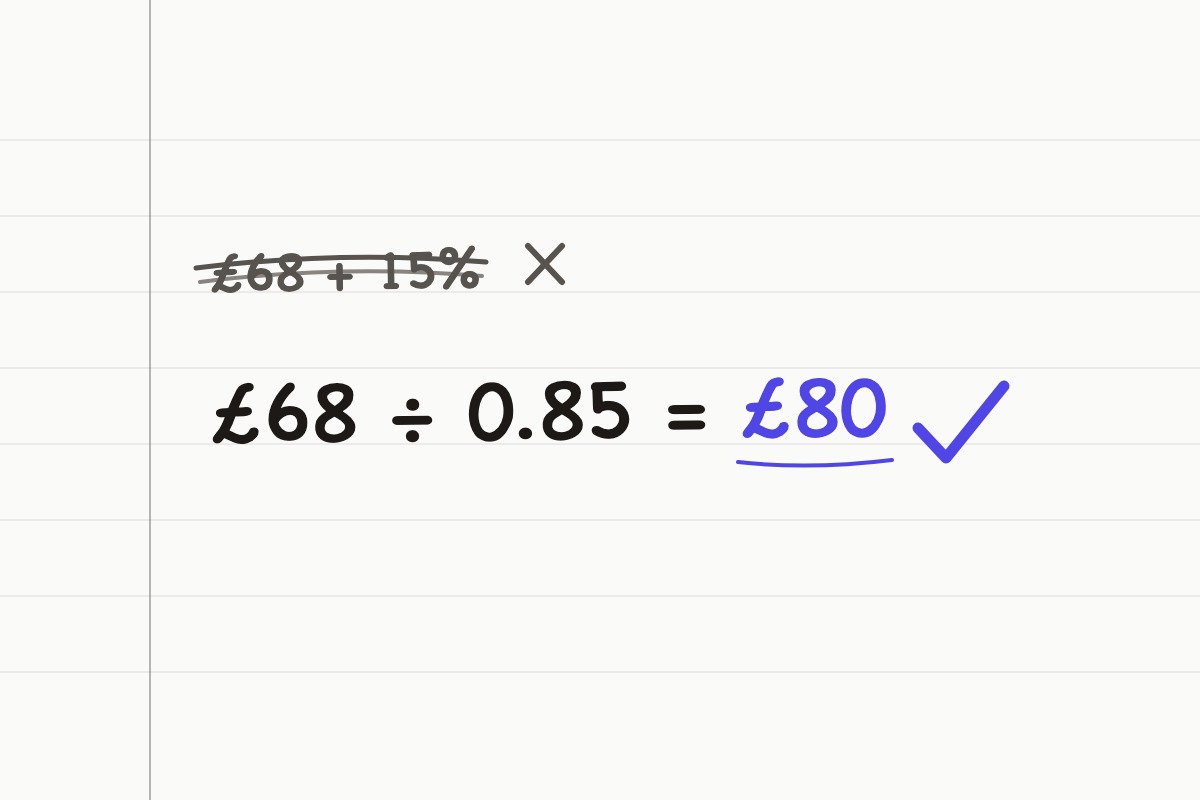
Every question below is the same shape: you are told what a value became, and asked what it was. Write the multiplier on its own line first — 85% = 0.85 — then divide. That single line is where the method marks live, and it survives an arithmetic slip at the final step. It also keeps you clear of the mistake almost everyone makes: adding the percentage back on. The unitary method (find 1%, scale to 100%) earns the same mark; use whichever you can do without a calculator.
Check each answer by going forwards. Reversing a discount must give a bigger number than the one in the question; reversing an increase must give a smaller one. If your answer sits on the wrong side, you multiplied where you should have divided, and you will catch it in seconds rather than losing the marks.
The higher-tier questions layer two changes. Multiply the multipliers together and divide once by the product — never add or subtract the percentages, and never divide twice with rounding in between.
Foundation
Single changes, friendly numbers.
Q1. A coat costs £48 in a sale after a 20% discount. What was the original price?
Show the answer
- 100% − 20% = 80%, so £48 is 80% of the original
- 80% = 0.8
- 48 ÷ 0.8 = 60
- Check: £60 − 20% = £48 ✓
Answer: £60
Q2. After a 10% increase, a bus fare is £2.20. What was it before?
Show the answer
- 100% + 10% = 110%, so £2.20 is 110% of the old fare
- 110% = 1.1
- 2.20 ÷ 1.1 = 2.00
- Check: £2.00 + 10% = £2.20 ✓
Answer: £2.00
Q3. A jacket is reduced by 25% to £45. Find the original price.
Show the answer
- 100% − 25% = 75%, so £45 is 75% of the original
- 75% = 0.75
- 45 ÷ 0.75 = 60
- Check: £60 − 25% = £45 ✓
Answer: £60
Q4. 30 is 40% of a number. What is the number?
Show the answer
- 30 is 40% of the number
- 40% = 0.4
- 30 ÷ 0.4 = 75
- Or, finding 1% first: 1% = 30 ÷ 40 = 0.75, so 100% = 0.75 × 100 = 75
- Check: 40% of 75 = 30 ✓
Answer: 75
Q5. A phone bill rose by 5% to £42. What was the bill before the rise?
Show the answer
- 100% + 5% = 105%, so £42 is 105% of the old bill
- 105% = 1.05
- 42 ÷ 1.05 = 40
- Check: £40 + 5% = £42 ✓
Answer: £40
Crossover
VAT, pay rises and depreciation.
Q6. A laptop costs £540 including 20% VAT. What is the price excluding VAT?
Show the answer
- 100% + 20% = 120%, so £540 is 120% of the net price
- 120% = 1.2
- 540 ÷ 1.2 = 450
- The VAT is £540 − £450 = £90
- Check: £450 + 20% = £540 ✓
Answer: £450
Q7. After a 12% pay rise, Amira earns £28,000. What did she earn before?
Show the answer
- 100% + 12% = 112%, so £28,000 is 112% of the old salary
- 112% = 1.12
- 28,000 ÷ 1.12 = 25,000
- Check: £25,000 + 12% = £28,000 ✓
Answer: £25,000
Q8. A car is now worth £7,200 after losing 40% of its value. What was it worth new?
Show the answer
- 100% − 40% = 60%, so £7,200 is 60% of the price when new
- 60% = 0.6
- 7,200 ÷ 0.6 = 12,000
- Check: £12,000 − 40% = £7,200 ✓
Answer: £12,000
Q9. A test score of 68% earned 51 marks. How many marks were available?
Show the answer
- 51 marks is 68% of the total
- 68% = 0.68
- 51 ÷ 0.68 = 75
- Check: 68% of 75 = 51 ✓
Answer: 75 marks
Q10. A shop reduces everything by 15%. A lamp now costs £38.25. Find its original price.
Show the answer
- 100% − 15% = 85%, so £38.25 is 85% of the original
- 85% = 0.85
- 38.25 ÷ 0.85 = 45
- Check: £45 − 15% = £38.25 ✓
Answer: £45
Q11. A population fell by 8% to 11,500. What was it before the fall?
Show the answer
- 100% − 8% = 92%, so 11,500 is 92% of the old population
- 92% = 0.92
- 11,500 ÷ 0.92 = 12,500
- Check: 12,500 − 8% = 11,500 ✓
Answer: 12,500
Q12. A restaurant bill including a 12.5% service charge comes to £81. What was the bill before service?
Show the answer
- 100% + 12.5% = 112.5%, so £81 is 112.5% of the bill before service
- 112.5% = 1.125
- 81 ÷ 1.125 = 72
- The service charge is £81 − £72 = £9
- Check: £72 + 12.5% = £81 ✓
Answer: £72
Higher
Consecutive changes and increases above 100%.
Q13. A price is increased by 20% and then reduced by 20%. The final price is £96. What was the original?
Show the answer
- Up 20% is 120% = 1.2; down 20% is 80% = 0.8
- Combined multiplier: 1.2 × 0.8 = 0.96 — the changes do NOT cancel, the item ends 4% cheaper
- 96 ÷ 0.96 = 100
- Check: £100 × 1.2 = £120, then × 0.8 = £96 ✓
Answer: £100
Q14. An investment grows by 6% in year one and 4% in year two, reaching £11,024. What was invested?
Show the answer
- Up 6% is 106% = 1.06; up 4% is 104% = 1.04
- Combined multiplier: 1.06 × 1.04 = 1.1024
- 11,024 ÷ 1.1024 = 10,000
- Check: £10,000 × 1.06 = £10,600, then × 1.04 = £11,024 ✓
Answer: £10,000
Q15. After two consecutive 10% reductions, a bike costs £324. Find the original price.
Show the answer
- Each 10% reduction leaves 90% = 0.9
- Combined multiplier: 0.9 × 0.9 = 0.81
- 324 ÷ 0.81 = 400
- Check: £400 × 0.9 = £360, then × 0.9 = £324 ✓
Answer: £400
Q16. A sofa costs £660 including 20% VAT, after a 12% discount was applied to the net price. What was the net price before the discount?
Show the answer
- VAT first: 100% + 20% = 120% = 1.2, so 660 ÷ 1.2 = 550 — the net price after the discount
- Then the discount: 100% − 12% = 88% = 0.88 (the two multipliers can be divided out in either order; the mistake is combining the percentages — 660 ÷ 1.08 = £611.11, not £625)
- 550 ÷ 0.88 = 625
- Check: £625 × 0.88 = £550, then × 1.2 = £660 ✓
Answer: £625
Q17. The number of members increased by 150% to 500. How many members were there before?
Show the answer
- An increase of 150% means the new figure is 100% + 150% = 250% of the old
- 250% = 2.5
- 500 ÷ 2.5 = 200
- Check: 200 + 150% = 500 ✓
Answer: 200
Q18. A shop claims "was £80, now £60". What percentage discount is that, and what price would a further 25% off give?
Show the answer
- The reduction is £80 − £60 = £20, and 20 ÷ 80 = 0.25 = 25%
- A further 25% off leaves 100% − 25% = 75%, and 75% = 0.75 (two 25% cuts are 0.75 × 0.75 = 0.5625 of the price, not 50% off — that would be £40)
- 60 × 0.75 = 45
- Check: £80 − 25% = £60, and £60 − 25% = £45 ✓
Answer: 25% off; £45
Check the first part with the percentage change calculator.
Check your working
Type the final value and the percentage from any question above. "Show steps" prints the multiplier line that carries the method mark. Marking your own paper? The marks percentage calculator turns a score out of a total into a percentage.
Frequently asked questions
What is a reverse percentage in GCSE maths?
A question that gives you the value after a percentage change and asks for the value before it. You divide by the multiplier rather than applying the percentage again.
Are reverse percentages on the foundation or higher paper?
Both. Foundation questions usually involve a single change with friendly numbers; higher papers add consecutive changes, VAT combined with a discount, and increases above 100%.
How many marks are reverse percentage questions worth?
Typically 2 to 4. Method marks are available for identifying the correct multiplier even if the final arithmetic slips, which is why writing the multiplier down first is worth doing.
Do two consecutive percentage changes cancel out?
No. A 20% increase followed by a 20% decrease gives 1.2 × 0.8 = 0.96, so you end up 4% below where you started. This is one of the most commonly examined misconceptions.
Is there a free reverse percentages worksheet with answers?
Yes. Every question on this page has full worked answers shown, and the same set is available as a printable PDF with the working included.
New to the topic? Start with how to do reverse percentages, or check your working with the calculator.
Updated